Two subjects, taught together
Physics
The usual problem is not the formula but the modelling: deciding what is being asked, which quantities are available, and what the answer should look like before calculating. Students who leap straight to an equation get stuck the moment the question is phrased unfamiliarly.
Chemistry
Moles, concentrations, stoichiometry and organic mechanisms. Much of the difficulty is bookkeeping: distinguishing a quantity from its symbol, tracking units through a calculation, and knowing which figure the question actually wants.
A worked example: units carry meaning
A car covers 150 km in 2 h 30 min. What is its average speed?
2 h 30 min = 2.5 h
v = d / t = 150 / 2.5 = 60 km h⁻¹
The arithmetic is trivial. Two things are not. First, the conversion: writing 2.5 rather than 2.30 is where a large share of lost marks live. Second, the interpretation — 60 km h⁻¹ is an average, and the car may never have travelled at that speed for a single second. A question asking “was the car speeding?” cannot be answered from this figure alone.
In a lesson we make the student state what they are looking for and in which unit before touching a calculator, then explain what the result means afterwards. The correction covers that whole path, not just the number.
Advanced-level work: mechanics, electricity, probability
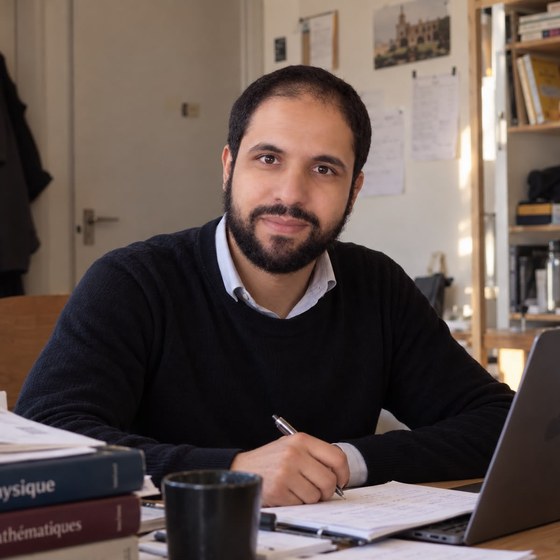
For students working at a higher level — the last years of a Swiss collège, an international syllabus, or the start of university — the questions usually combine several ideas at once rather than testing one formula in isolation. Abderrahman, who holds a PhD in physics, works specifically at that level: mechanics, electricity and the probability questions that turn up inside physics problems.
French curriculum and international syllabuses
The scope of French physique-chimie does not map cleanly onto IGCSE Combined Science or IB Physics and Chemistry. Practical write-ups, the weight given to the experimental method, and the expected level of mathematical treatment all differ. We match the tutor to the syllabus your child sits, and teach in the language they are examined in.